
.webp&w=3840&q=75)
Chest Tube Troubleshooting & Emergencies: NCLEX Cheat Sheet
Chest tube management is one of the most intimidating clinical skills for nursing students and new staff nurses. Whether you're facing a real clinical emergency in the ICU, Whether you're preparing for an OSCE skills station or tackling high-priority questions on the NCLEX-RN, knowing exactly what to do when things go wrong is critically important.
At MedicoTrick, we believe in cutting out the unnecessary. This evidence-based chest tube troubleshooting cheat sheet explains chamber dynamics, air leaks, and precise nursing actions for life-threatening chest tube emergencies.
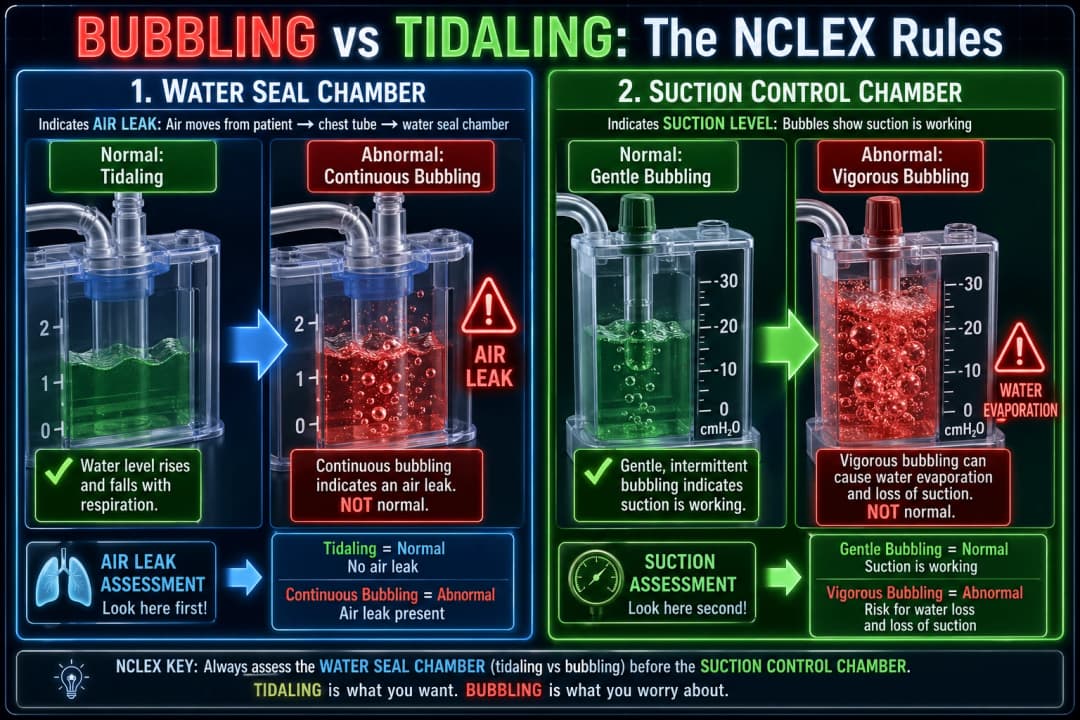
1. Decoding the Chambers: Bubbling vs. Tidaling
Knowing what is “normal” within the drainage system is the most common point of confusion. Board exams often test your ability to differentiate between water seals and suction control chambers.
System Chamber | What is Normal? | What is ABNORMAL? (Red Flag) | Clinical Meaning |
Water Seal Chamber | Tidaling (Water level moves UP when inhaling, DOWN when exhaling). Intermittent Bubbling (Only when coughing & sneezing). | Continuous Bubbling meaning = Active Air Leak in the system & the patient's lung. | If the flow of fluid in the chest tube suddenly stops, it means the lung has fully re-expanded, or there is a blockage or kink in the tube. |
Suction Control Chamber (Wet System) | Gentle, Continuous Bubbling. | Vigorous, violent bubbling. (This just evaporates the sterile water faster or makes noise; it does not pull more suction). | Confirms that the wall suction is working correctly. |
Collection Chamber | Serosanguineous & serous fluid. Output < 100 mL/hr. | Sudden gush of bright red blood OR Output > 100 mL/hr. | Indicates active hemorrhage. Nursing Action: Notify the provider immediately. |
.webp&w=1080&q=75)
2. Chest Tube Emergencies: The "What If" Scenarios
When an emergency occurs, you have only a few seconds to act. Here are precise, step-by-step nursing interventions for the most common chest tube disasters.
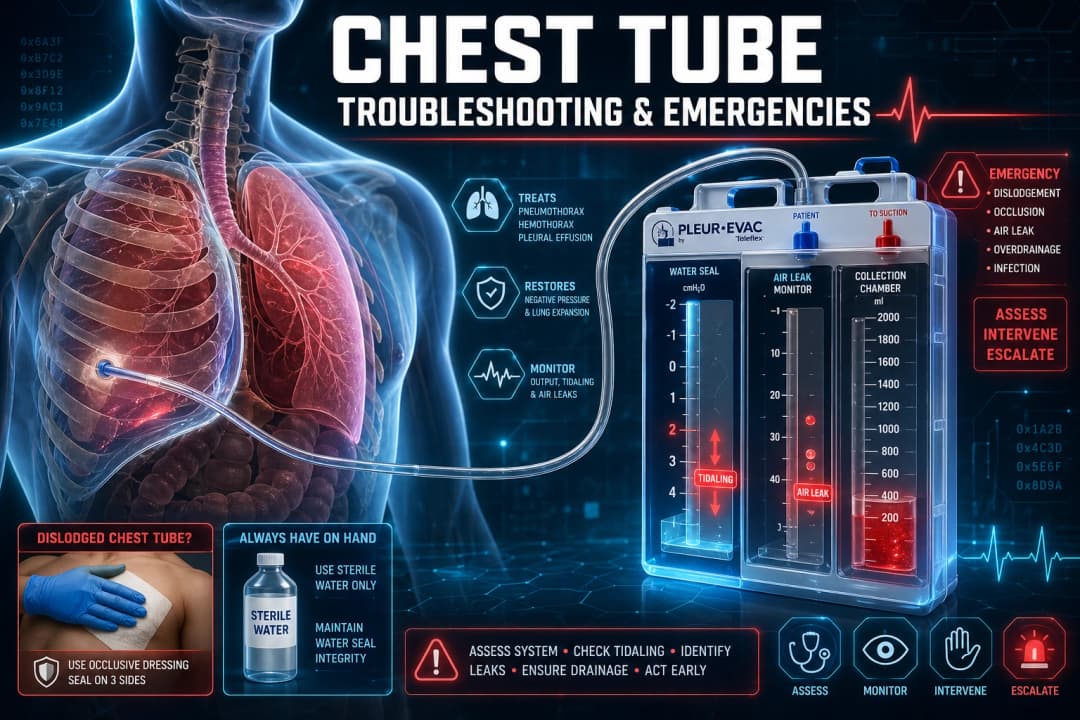
Emergency A: Chest Tube is Pulled Out (Dislodgement)
The patient is disoriented and has accidentally pulled the chest tube completely out of the chest wall.
Step 1: Apply pressure immediately! Cover the entry site with your gloved hand.
Step 2: Apply a sterile Vaseline gauze. Ask a colleague to bring a sterile closure dressing (Vaseline/petroleum gauze) and place it immediately over the hole.
Step 3: Tape it on only three sides.
Reason (Why): Taping it on 3 sides creates a flutter valve. As the patient exhales, trapped air escapes through the untaped side. If you tape all 4 sides, the air will get trapped inside, causing a life-threatening tension pneumothorax.
Emergency B: Chest Tube Disconnected from the Drainage System
The tubing detaches from the PulmoVac/drainage box, and the tube hangs loosely.
Step 1: Submerge in sterile water. Immediately take the end of the chest tube coming from the patient and submerge it 1 to 2 inches into a bottle of sterile water (or sterile normal saline).
Step 2: Keep it below chest level.
The reason: Submerging the tube creates a temporary, on-the-spot water seal. This prevents atmospheric air from returning to the patient's pleural space, which could collapse the lung.
Emergency C: When to Clamp a Chest Tube?
Golden rule: Never clamp a chest tube during routine care or transport.
Exception (when you can clamp):
For a brief moment (less than 1 minute) to locate the source of an air leak.
To replace a full drainage system box.
To check if the patient is ready for tube removal (usually done by a provider).
Risk: Clamping the chest tube occludes the air escape path, causing rapid tension pneumothorax.
3. Clinical Assessment & Routine Skills
For staff nurses and OSCE evaluations, proper assessment and documentation are important.
Subacute Emphysema (Crepitus)
When you palpate the skin around the chest tube dressing, you will feel a “crackling” or “rice Krispies” sensation under the skin. This is subcutaneous emphysema—a leak of air into the tissue.
Action: A small amount of this around the entry site is expected. Border the area with a medical marker. If the swelling rapidly spreads upward into the neck or face, it becomes an airway emergency. Notify the provider.
Milking vs. Stripping a Chest Tube
Stripping: Squeezing the tube forcefully and pulling it down its length to expel clots.
Action: Never do this. It creates dangerously high negative pressure that damages lung tissue.
Milking: Gently squeeze and release small segments of the tube. Only do this when strictly ordered by a physician or when instructed by hospital policy to clear a visible clot.
4. NCLEX-RN Knowledge Check: Test Yourself
Let's see if you can apply these rules to a board-style question!
Scenario: You are assessing a patient with a chest tube for a right pneumothorax. You are observing continuous bubbling in the water seal chamber. What is your most appropriate nursing action?
A) Record this finding as normal.
B) Check the system connections from the patient to the drainage unit.
C) Immediately increase the wall suction.
D) Securely clamp the chest tube near the insertion site.
(Answer: B — Continuous bubbles in the water seal chamber indicate an active air leak. You should assess the tubing connections to determine where room air is entering the system.)