
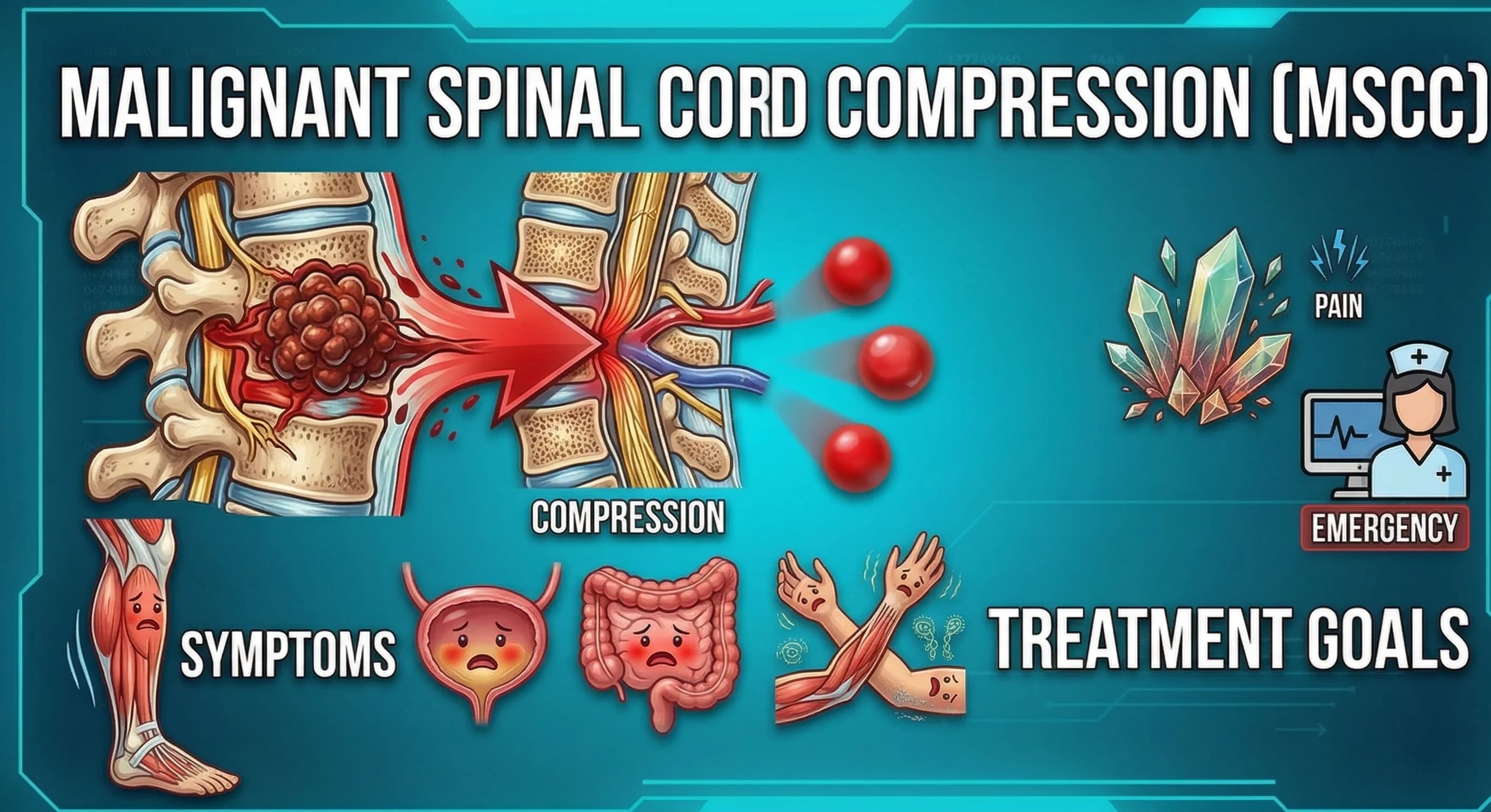
Malignant Spinal Cord Compression (MSCC): Pathophysiology, NCLEX Notes & Nursing Care Plan
Malignant spinal cord compression (MSCC) is a serious oncological and neurological emergency. It occurs when a metastatic tumor presses on the dural sac, the spinal cord, or the nerve roots. For nursing and medical students worldwide preparing for the NCLEX-RN, OSCEs, or global board exams, rapid recognition of MSCC is a high-yield topic. A delayed response can also lead to irreversible paraplegia or quadriplegia in the patient.
In this comprehensive guide, we provide a detailed description of the essential pathophysiology of MSCC, early warning signs, and evidence-based emergency nursing interventions.
The Pathophysiology of MSCC
In oncology, spinal cord compression rarely originates from the spine itself. It most commonly results from metastasis (the spread of cancer to the bone). The most common primary cancers that cause MSCC are:
Breast cancer
Lung cancer
Prostate cancer
The Cascade of Compression:
A metastatic tumor grows into the epidural space --> it compresses the venous plexus, causing venous stasis and edema --> the edema further compresses the arterial blood supply --> ischemia in the spinal cord tissue (oxygen deprivation) occurs --> acute neurological deficits develop.
Clinical Manifestations: The 3 Early Red Flags
Global board exams like the NCLEX often test your ability to recognize early symptoms before permanent paralysis occurs.
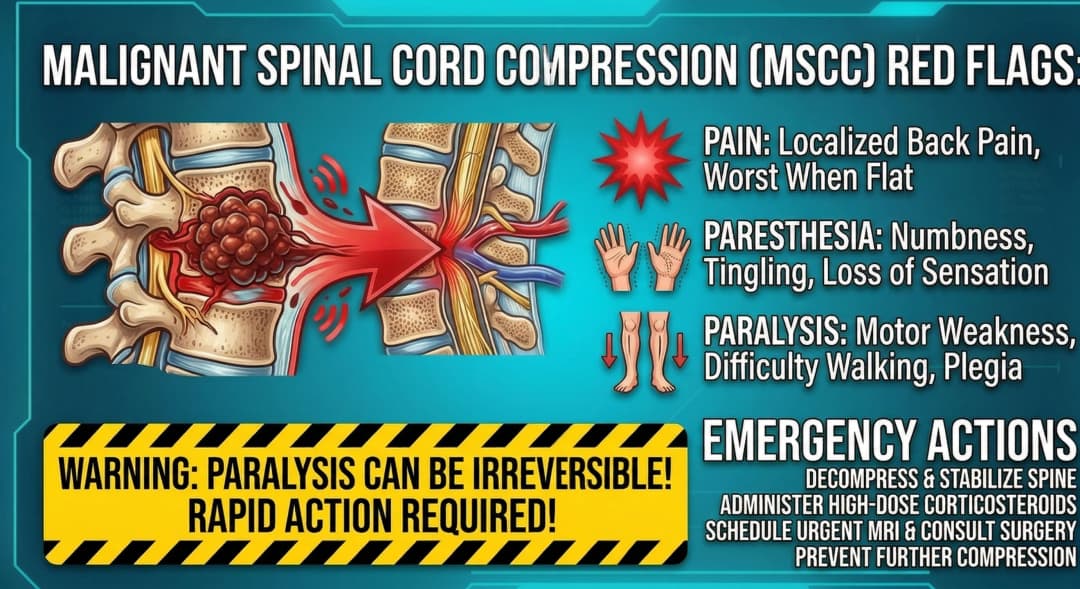
1. New or Worsening Back Pain (The Earliest Sign)
Incidence: It is present in more than 90% of patients before any other neurological symptoms
Key Characteristic: Unlike mechanical back pain, MSCS pain is usually localized, gradually worsens, and is aggravated by lying flat on the back, coughing, or using the Valsalva maneuver (applying pressure).
2. Motor Weakness
Patients often complain of a “heavy” sensation in their legs.
Difficulty climbing stairs, an unsteady gait, or having recently fallen for no apparent reason.
3. Sensory Deficits (Paresthesia)
Numbness, tingling, or loss of sensation that starts in the toes and travels upward.
A sensation of a tight band around the chest or abdomen at the level of the tumor (radicular pain).
Critical Alert (Late Sign): Serious warning (late-appearing sign): autonomic nervous system dysfunction, such as bowel or bladder incontinence (or urinary retention), is a late-appearing medical emergency that indicates severe spinal cord injury.
Emergency Nursing Management & Interventions
The primary goals in the management of MSCC are to preserve neurological function and stabilize the spine.
1. Strict Spinal Alignment (Priority Nursing Action)
Bed Rest: The patient should be kept on a firm, flat bed until spinal instability is ruled out by MRI.
Log-roll technique: When repositioning the patient for skin care or assessment, use the log-rolling method with at least two to three healthcare professionals. To prevent twisting the body and placing additional pressure on the spine, rotate the patient as a single unit.
2. Pharmacological Interventions
High-dose corticosteroids (such as dexamethasone): This is the first-line drug for emergency medical treatment. It rapidly reduces vascular inflammation around the spine, thereby reducing pressure and pain.
Nursing considerations: High-dose steroids cause hyperglycemia, so blood sugar levels must be closely monitored.
Analgesia: Administer opioids prescribed for the management of severe nerve and bone pain.
3. Continuous Neurological Assessments
Perform baseline and continuous neuro-checks every 2 to 4 hours.
Assess motor strength (pushing/pulling against resistance), sensory level (using light touch or pinprick), and monitor strict intake and output (I/O) to promptly detect urinary retention.
.webp&w=1080&q=75)
Standardized Nursing Care Plan (NCP) for MSCC
Nursing Diagnosis | Evidence-Based Nursing Interventions | Clinical Rationale |
|---|---|---|
Impaired Physical Mobility r/t neuromuscular impairment and prescribed bed rest | Apply firm bed rest. Use the log-roll technique for all repositionings. Provide a pressure-relieving mattress. | Maintain spinal alignment to prevent further neurological damage and avoid pressure ulcers. |
Impaired Urinary Elimination (Retention) r/t autonomic nerve dysfunction | Palpate the bladder for swelling. Perform an ultrasound scan of the bladder. If ordered, also prepare to insert an indwelling catheter. | Compression of the sacral nerve roots disrupts normal bladder sphincter control, resulting in urinary retention. |
Acute Pain r/t tumor compression on spinal nerves | Administer the prescribed corticosteroids and analgesic medications. Be sure to assess pain before and after administering the medication using a standardized scale (0–10). | Corticosteroids reduce local inflammation, thereby relieving direct pressure on the nerve roots. |
Quick Table for NCLEX Revision
Feature | Finding |
|---|---|
First Sign | Persistent, localized back pain |
Emergency Drug | High-dose Dexamethasone |
Diagnostic Test | MRI of the Spine |
Nursing Goal | Maintain spinal stability & Neuro-checks |
Late Complication | Autonomic dysfunction (Bladder/Bowel) |
Frequently Asked Questions (FAQs) on MSCC
1. What is the first clinical sign of MSCC?
Answer: Localized back pain is the earliest symptom, seen in over 90% of cases. It often occurs days or weeks before neurological deficits. It is typically described as “non-mechanical” pain that worsens when the patient lies flat or coughs.
2. Why is MSCS considered a medical emergency?
Answer: Because prolonged pressure leads to permanent spinal cord ischemia and infarction. If it is not treated within 24–48 hours of the onset of motor weakness, the risk of permanent paralysis (paraplegia or quadriplegia) increases dramatically.
3. What could be the “gold standard” diagnostic imaging for MSCC?
Answer: An MRI of the entire spine. While an X-ray or CT scan can also detect bone metastases, an MRI is necessary to visualize the soft tissue tumor, the dural sac, and the extent of cord compression.