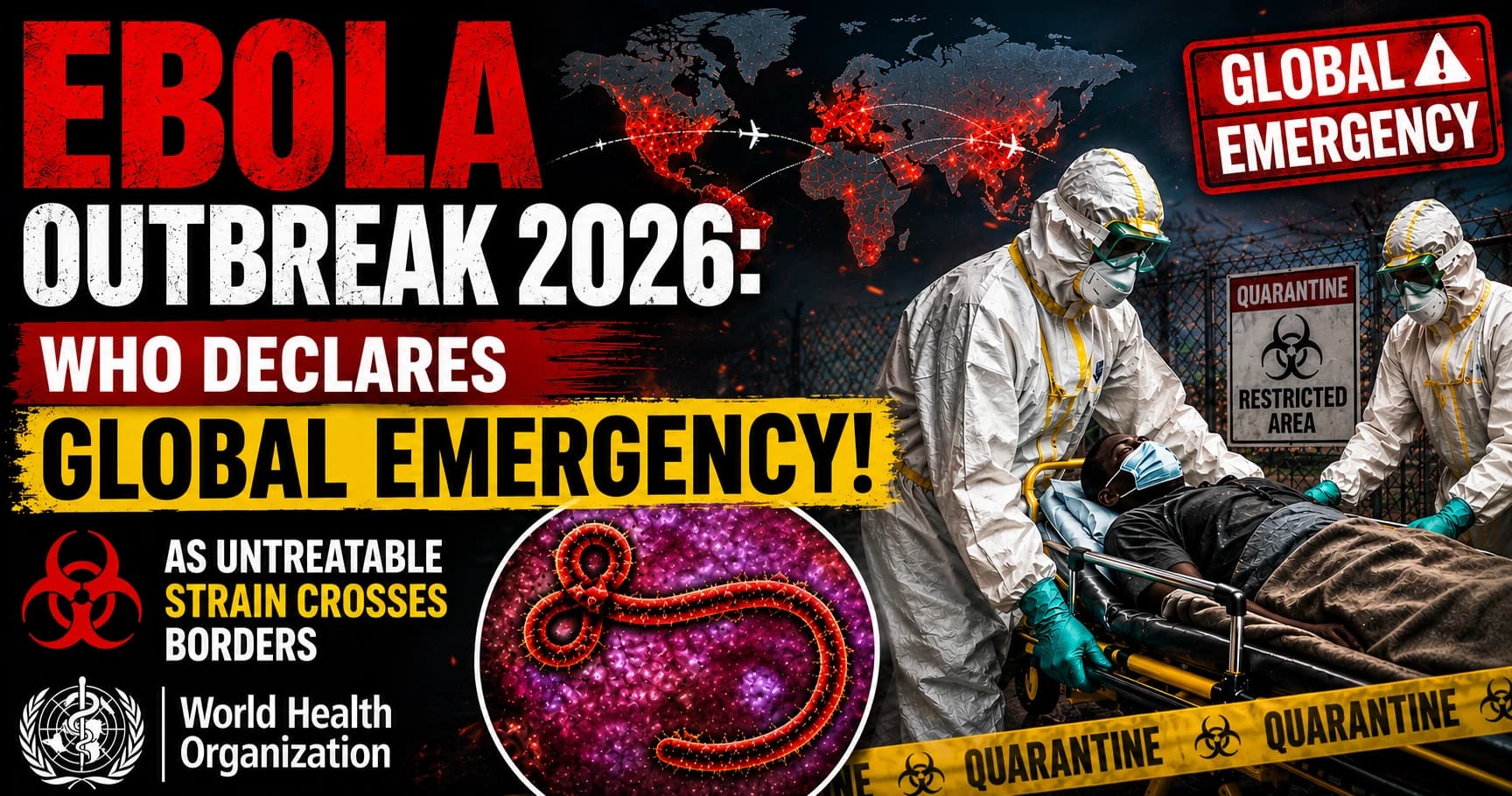
Ebola Outbreak 2026: WHO Declares Global Emergency as Untreatable Strain Crosses Borders
The Bundibugyo virus — for which no approved vaccine or treatment exists — has claimed more than 80 lives in the DRC and has spread to Uganda's capital, prompting the WHO to issue its highest level public health alert and raising serious questions about the weakening global response network.
Executive Summary
The World Health Organization has declared the 2026 Ebola epidemic a Public Health Emergency of International Concern (PHEIC). The outbreak — driven by the rare Bundibugyo virus with no approved treatment or vaccine — has killed 80+ in the DRC and reached Uganda's capital within days. Global responders are scrambling, but experts warn that USAID cuts and US WHO withdrawal may leave dangerous gaps in the world's defences.
80+ Suspected Deaths (DRC)
246 Suspected Cases
8 Lab-Confirmed Cases
2 Confirmed in Uganda
17th DRC Outbreak Since 1976
40% Max Fatality Rate (BVD)
What Is Happening — and Why Is It Different?
On May 16, 2026, health officials in the Democratic Republic of Congo officially announced a new Ebola outbreak centered in the country's restive northeastern Ituri province. At least 80 deaths were recorded, 246 suspected cases emerged, and health workers scrambled to ramp up screening and contact tracing to contain the disease. Local residents described a terrifying new rhythm to daily life.
What makes this outbreak particularly concerning is the specific strain responsible. Test results have confirmed it is the Bundibugyo virus, a new variant of the Ebola disease that has been less prominent in Congo's past outbreaks. According to CBS News medical correspondent Dr. Celeste Gondar, the Bundibugyo virus has been responsible for only two previous Ebola outbreaks — one in Uganda in 2007 with 55 cases, and another in Congo in 2012 with 57 cases. There are no approved vaccines or treatments for this strain.
The potential point of origin adds another layer to the tragedy: The first suspected case is a nurse who died at a hospital in Bunia, and the case dates back to April 24. Healthcare workers infected in a clinical setting with little warning or protection are now among the casualties — a pattern that, if left unchecked, threatens a dramatic escalation of the epidemic.
"Every day, people are dying … and this has been going on for about a week. In a single day, we bury two, three or even more people."— Jean Marc Asimwe, resident of Bunia, Ituri Province (CBS News)
Key Timeline of Events
Apr 24:- Suspected index case — a nurse — dies at Bunia hospital, Ituri Province.
May 14:- A traveller from DRC dies at Kibuli Muslim Hospital in Kampala, Uganda — the first confirmed cross-border case.
May 15–16:- DRC officially announces the outbreak. 65 deaths and 246 suspected cases reported. Two additional confirmed cases emerge in Kampala within 24 hours of each other.
May 16:- WHO reports 80 suspected deaths and 8 confirmed cases. Bundibugyo strain confirmed. Seven metric tons of emergency medical supplies dispatched to Bunia.
May 17:- WHO Director-General declares a Public Health Emergency of International Concern (PHEIC).
May 18:- US CDC confirms it is working to relocate a "small number" of Americans potentially exposed. Global coordination efforts intensify.
The WHO Declares a PHEIC — What Does That Mean?
On May 17, the WHO Director-General took the decisive step of raising the outbreak to a Public Health Emergency of International Concern (PHEIC) — considered the highest level of alert available under the International Health Regulations. This is the same designation that was used for the COVID-19 and the 2022 monkeypox outbreaks.
The WHO determined that this event is unusual for several reasons: The high positivity rate of initial samples (8 out of 13 samples positive), confirmation of cases in several health zones in Kampala and Ituri, and an increasing trend in clusters of suspected cases and deaths all point to a potential outbreak much larger than the one currently being detected and reported.
International spread has already occurred, with two confirmed cases in Kampala, Uganda, on May 15 and 16 following travel from the Democratic Republic of Congo. Neighboring countries that share a land border with the DRC were considered to be at high risk of further spread due to population movements, trade and travel links, and ongoing epidemiological uncertainty.
Critical Risk Factor
Unlike Ebola-Zaire strains — for which approved vaccines like rVSV-ZEBOV exist — there are currently no approved Bundibugyo virus-specific therapeutics or vaccines. The WHO has urged clinical trials to advance candidate treatments, but as of now, response relies entirely on isolation, contact tracing, and supportive care.
WHO's guidance is comprehensive: exit screening at all international airports and seaports; no international travel for confirmed cases or their contacts; postponement of large events; and a robust supply chain for personal protective equipment. Importantly, the WHO advised that no country should close its borders or impose restrictions on travel and trade, noting that such measures encourage movement to unregulated informal cross-border routes and increase the spread of the disease.
On the Ground: Conflict, Displacement, and Broken Infrastructure
The epicenter of this outbreak could hardly be in a more difficult operational environment. Ituri province is about 620 miles from Congo's capital, Kinshasa, and it is ravaged by violence from Islamic State–backed militants. The same remote, conflict-ridden area that made the 2018–19 North Kivu outbreak possible — which became the second deadliest Ebola outbreak in history — now provides the backdrop for this outbreak.
Complicating the response is that this outbreak is occurring amid a humanitarian crisis, where conflict in the DRC's eastern provinces has also displaced millions of people and weakened health systems.
The two confirmed cases in Kampala, the capital of Uganda, had no apparent link to each other — a detail that has alarmed epidemiologists. Adrian Esterman, a professor and chair of biostatistics at the University of Adelaide, said that unrelated cases in a foreign capital “are often a warning sign that the outbreak in the DRC is much larger than is currently perceived by health officials.”
"There are significant uncertainties to the true number of infected persons and geographic spread associated with this event at the present time."— WHO Director-General's PHEIC Determination Statement, May 17, 2026
At least four deaths of healthcare workers have been reported in a suspected clinical context of viral hemorrhagic fever, raising concerns about health-related transmission, deficiencies in infection prevention and control, and the potential for its spread within healthcare facilities.
The US Response — and a Troubling Absence
Historically, the United States has been the largest external actor in Ebola outbreak response, with USAID teams deployed in at-risk countries even before an outbreak was declared. That system has now been largely dismantled.
Experts worry that the cuts to USAID by the Trump administration and its withdrawal from the WHO could affect response efforts. Dr. Craig Spencer — a New York emergency physician who was infected with Ebola and survived more than a decade ago — made his assessment clear: “Before the second Trump administration, USAID was on the ground. The CDC was on the ground as soon as a new Ebola outbreak was reported, maybe even before, because we were present in many countries. We had already established relationships.”
Spencer also suggested a potential link between the weakening of USAID and the delayed announcement of the outbreak, which also raises questions about early warning gaps in the global surveillance system.
On the operational side, the U.S. CDC said it was “supporting interagency partners in efforts to evacuate some U.S. citizens directly affected by this outbreak” to evacuate “some U.S. citizens directly affected by this outbreak.” The CDC's Ebola Response Incident Manager declined to confirm whether any Americans had been infected, but they did confirm that the agency is deploying resources already present in the country to assist with surveillance, contact tracing, and laboratory testing.
Global Response: Racing to Scale Up
According to the WHO, on Sunday approximately seven metric tons of emergency medical supplies, including protective equipment, tents, and bedding, arrived in Bunia, the capital of Ituri, to bolster frontline response efforts.
Non-governmental organizations like Doctors Without Borders (MSF) are also preparing to launch a large-scale response as soon as possible. MSF has described the rapid spread as “extremely worrying.” The group estimates the mortality rate in Bundibugyo is between 25% and 40% — dramatically higher than seasonal influenza, but lower than some past Ebola-Zaire outbreaks.
Kenya, which borders Uganda, has declared the risk of importation “moderate” and has activated a preparedness team with surveillance at all points of entry. The Africa CDC has similarly warned of an increased risk for South Sudan due to patterns of population movement across the border.
What to Watch For
The next two to three weeks will be defining. Contact tracing teams in both Bunia and Kampala must work quickly to map the full chain of transmission before the 21-days incubation window allows further undetected spread. The key indicators to monitor:
1. Epidemiological links between Kampala cases. If the two confirmed Uganda cases remain unlinked to each other and to known DRC contacts, the true size of the outbreak in Ituri may be far larger than reported figures suggest.
2. Healthcare worker infections. With 4 health worker deaths already reported, any further nosocomial spread signals a breakdown in infection control that can exponentially accelerate an outbreak.
3. Progress on candidate therapeutics. The WHO has called on partners to urgently advance clinical trials for Bundibugyo-specific treatments. The pace of that process — historically slow — will be a defining factor in whether fatality rates can reduced.
4. US institutional capacity. With USAID diminished and US-WHO relations severed, the architecture of the world's outbreak response has changed. Whether alternative partners can fill that's gap in real time remains an open and urgent question.
The Bottom Line
The 2026 Ebola outbreak is, in many ways, a worst-case scenario stress test for the global health infrastructure. A rare strain of Ebola, for which there is no approved treatment, is emerging in a conflict zone, in a country with weak health systems, just as the major external funder of the outbreak response has withdrawn from the region.
A WHO PHEIC declaration activates international coordination mechanisms and signals to the world that this is not a regional problem. But declarations are only as powerful as they are in accelerating the response. The coming weeks will tell if the global community — with or without full U.S. participation — can contain a disease that, within two weeks of detection, has crossed an international border and reached a major African capital.
Primary Sources
CBS News — "Frequent burials and at least 80 dead as Congo grapples with Ebola outbreak" (May 16, 2026)
World Health Organization — PHEIC Declaration Statement (May 17, 2026)
CNN — "Global scramble to contain new Ebola outbreak" (May 18, 2026)