
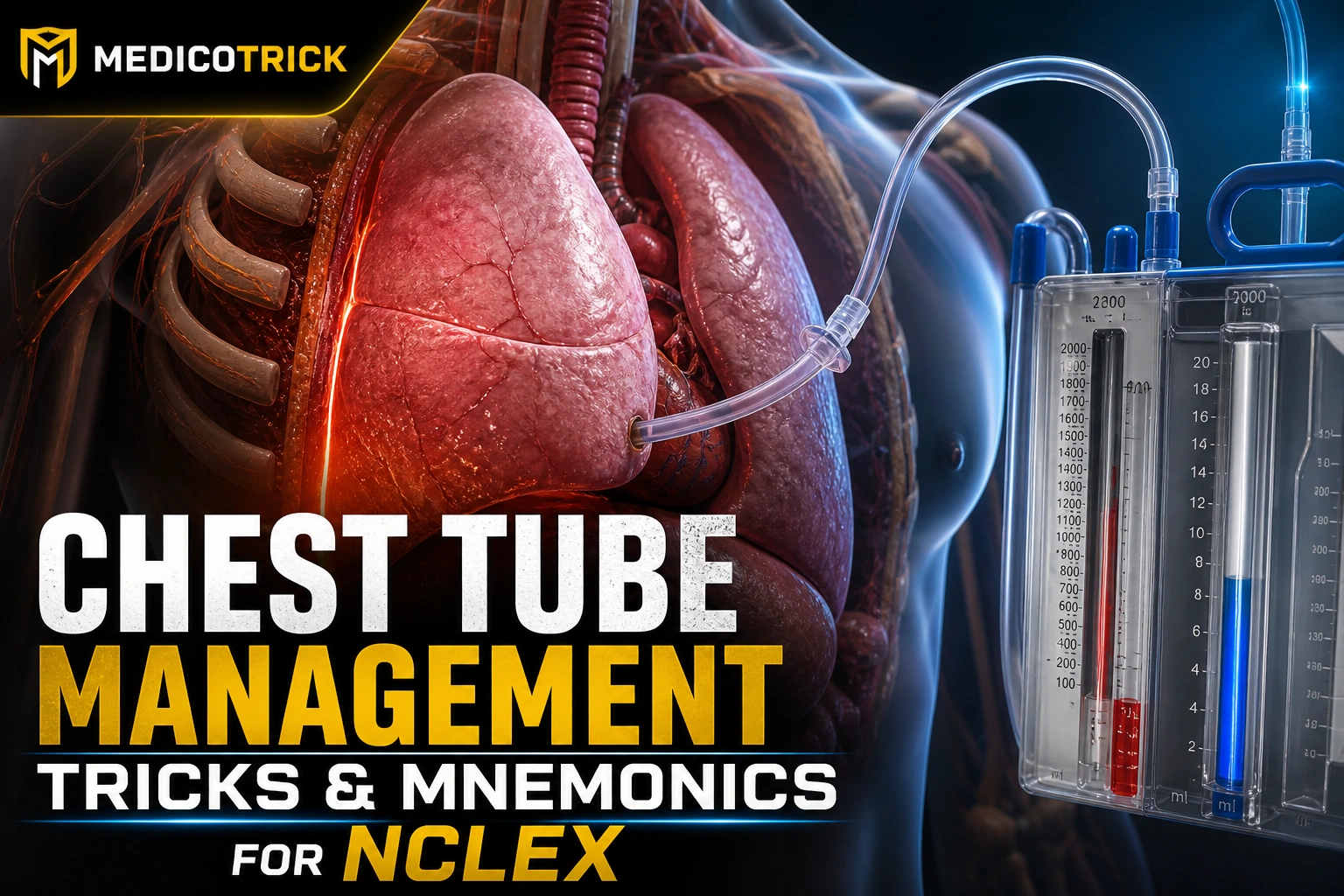
Chest Tube Management Tricks & Mnemonics for NCLEX
The Golden Rule Trick: "Air Rises, Fluid Falls" The "W-S" Mnemonic for Bubbling Tidaling = Tides of the Ocean
Explanation & Breakdown
Let's face it: chest tubes can be really confusing. Between the different chambers, the rules of bubbling, and emergency protocols, it's all too easy to get overwhelmed during nursing exams or clinical shifts.
However, global board exams like the NCLEX, OSCE, and NORCET love testing these concepts. If you're looking for an easy mnemonic trick for chest tube bubbling or just want to simplify your study sessions, these are for you.
Here are the best chest tube management tricks to help you remember the rules in seconds and never miss a question again!
1. Pneumothorax vs Hemothorax Chest Tube Placement Trick
Exam questions often ask where a provider places a chest tube based on a patient's diagnosis. You don't need to remember precise anatomy to get this right; you just need the basic tricks!
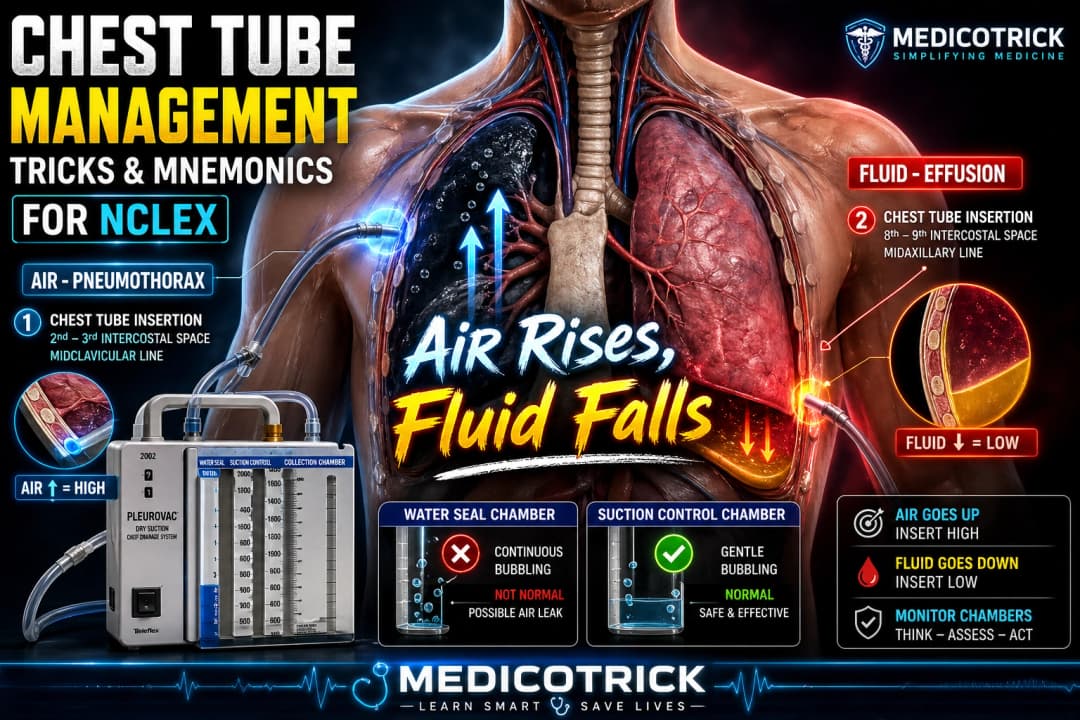
The Golden Rule Trick: “Air rises, fluid falls”
Pneumothorax (air in the pleural space): Because air is lighter, it rises to the top of the lungs. Therefore, the chest tube placement is higher (typically anteriorly, in the second or third intercostal space).
Hemothorax / Pleural Effusion (blood or fluid): Since fluid is heavy, gravity pulls it to the lower part of the lungs. Therefore, the chest tube placement will be lower (usually, laterally, in the eighth or ninth intercostal space).
NCLEX Hack: If patient has both (Hemopneumothorax), they will likely have two tubes—one high and one low!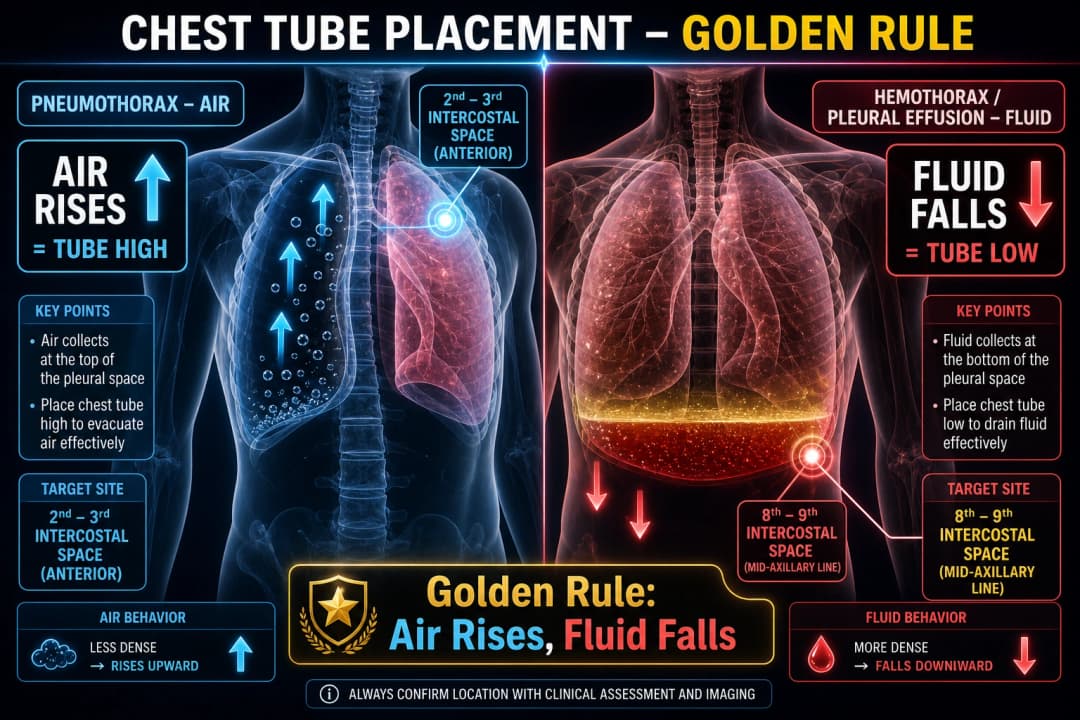
2. How to Remember Chest Tube Chambers NCLEX
What is inside the drainage box is the most frequently tested area. If you are struggling with how to remember chest tube chambers NCLEX, be sure to use the “W-S” rule.
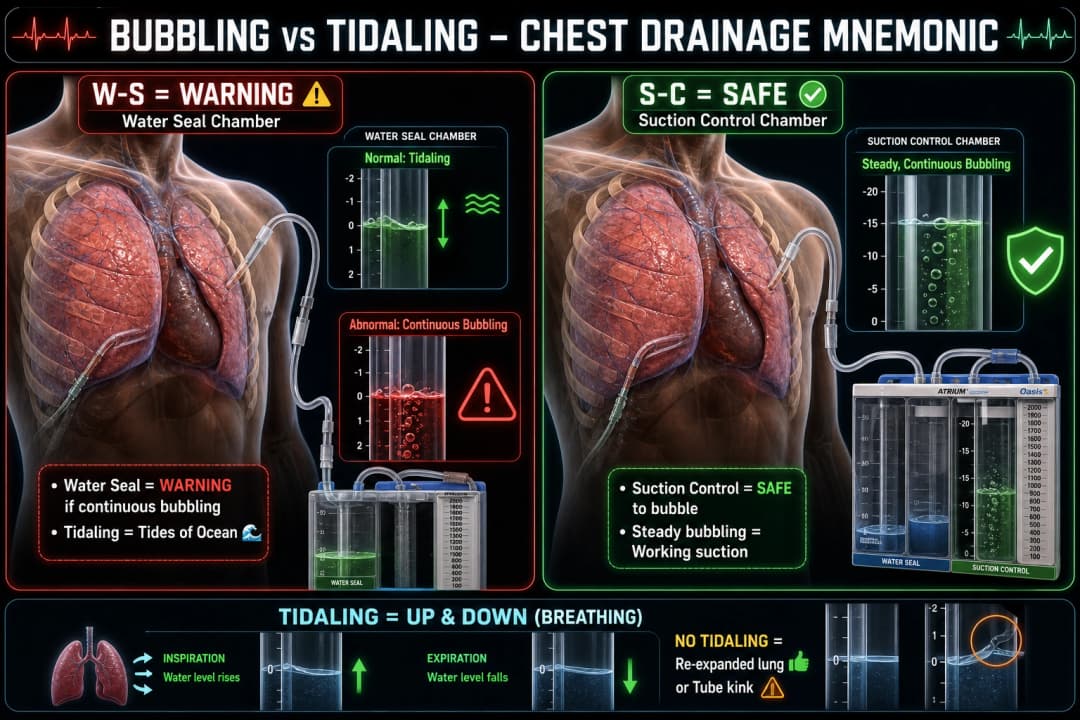
The “W-S” mnemonic for bubbling
Water seal chamber = Warning if constant!
• Trick: The Water seal should only have a slight ripple (tidal action). If you see continuous bubbles here, it is a Warning sign of an air leak.
Suction Control Chamber = Safe to bubble!
• Trick: The Suction control should have Steady, continuous bubbles. This means the wall Suction is working perfectly Safely.
Tidaling Memory Trick
Tidaling = Tides of the Ocean. Just as ocean waves rise and fall with the moon, the water level in the water-seal chamber should rise and fall with the patient's breathing. If the “wave” suddenly stops, then either the lung has fully re-expanded (wow!) or the tube has kinked (oh-oh!).
3. Valsalva Maneuver for Chest Tube Removal Explained
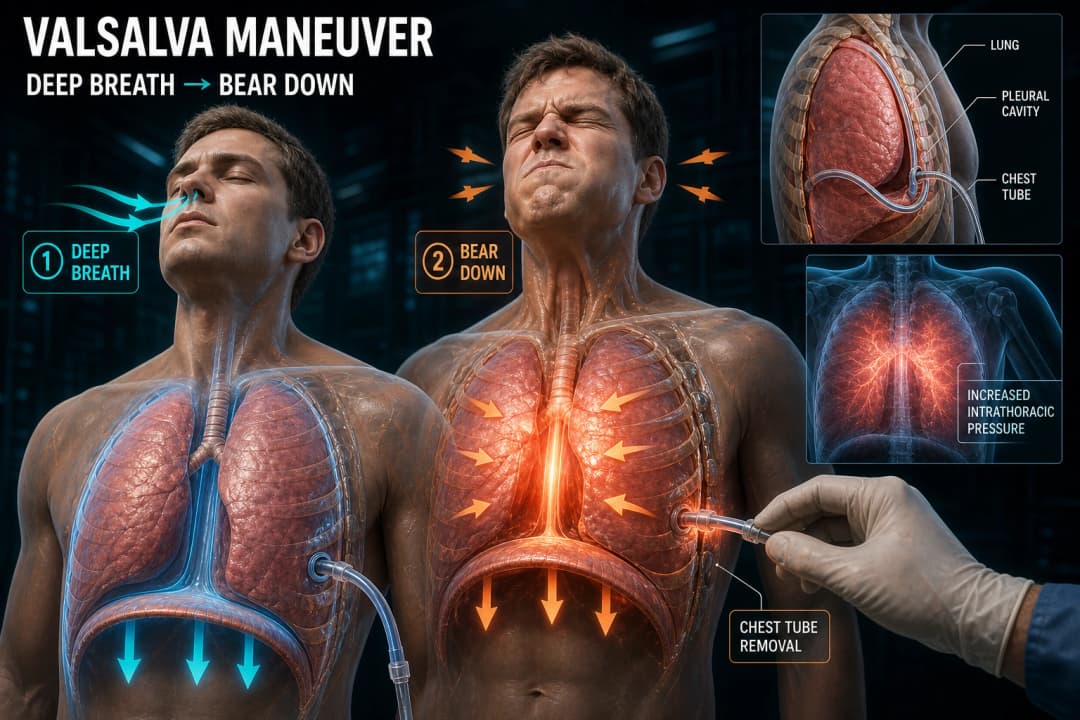
When the patient's lung is fully recovered, the doctor will remove the chest tube. It is the nurse's job to instruct the patient on exactly how to breathe during the tube removal. The best method for this is the Valsalva maneuver.
What is the Valsalva maneuver?
Instruct the patient: “Take a deep breath in, let it out, and bear down (as if you are having a bowel movement).”
Why do we do this? (Clinical reasoning)
The Valsalva maneuver for chest tube removal is explained simply here: When the patient bears down, it dramatically increases the intrathoracic pressure. This high internal pressure acts like an invisible shield, which prevents the nurse from closing the opening with stitches and an occlusive dressing. (occlusive dressing) is applied, preventing atmospheric room air from re-entering the chest cavity through the open hole.
If they breathe normally during removal, they will immediately develop a pneumothorax.
Do you want to master the precise nursing interventions performed when a chest tube disconnects or comes out?
👉 Read our complete [Chest Tube Troubleshooting and Emergency Cheat Sheet]
Latest Vacancies

AIIMS CRE 5 Recruitment 2026: Online Applications Open for 1488 Posts – Check Full Details
AIIMS

UKMSSB Nursing Officer Recruitment 2026: 196 Vacancies Released – Check Eligibility, Salary & Apply Online
UKMSSB
Jharkhand Nursing Staff Vacancy 2026 – 7609 Posts, Eligibility, Syllabus, Salary & How to Apply
Govt hospital
MPSC Nursing Officer Recruitment 2026 – 42 Vacancies Open, Apply Online Before June 12

HBCH&RC Muzaffarpur Nurse Vacancy 2026: 60 Posts Walk-In Interview on 26 May, Salary up to ₹33,000
HBCH&RC
Recent Mnemonics

12 Cranial Nerves Mnemonic Learn in 30 Seconds For Medical Students
#Medical Surgical
100 Surgical Signs Cheat Sheet: Top List + Visual Mnemonics
#Medical Surgical
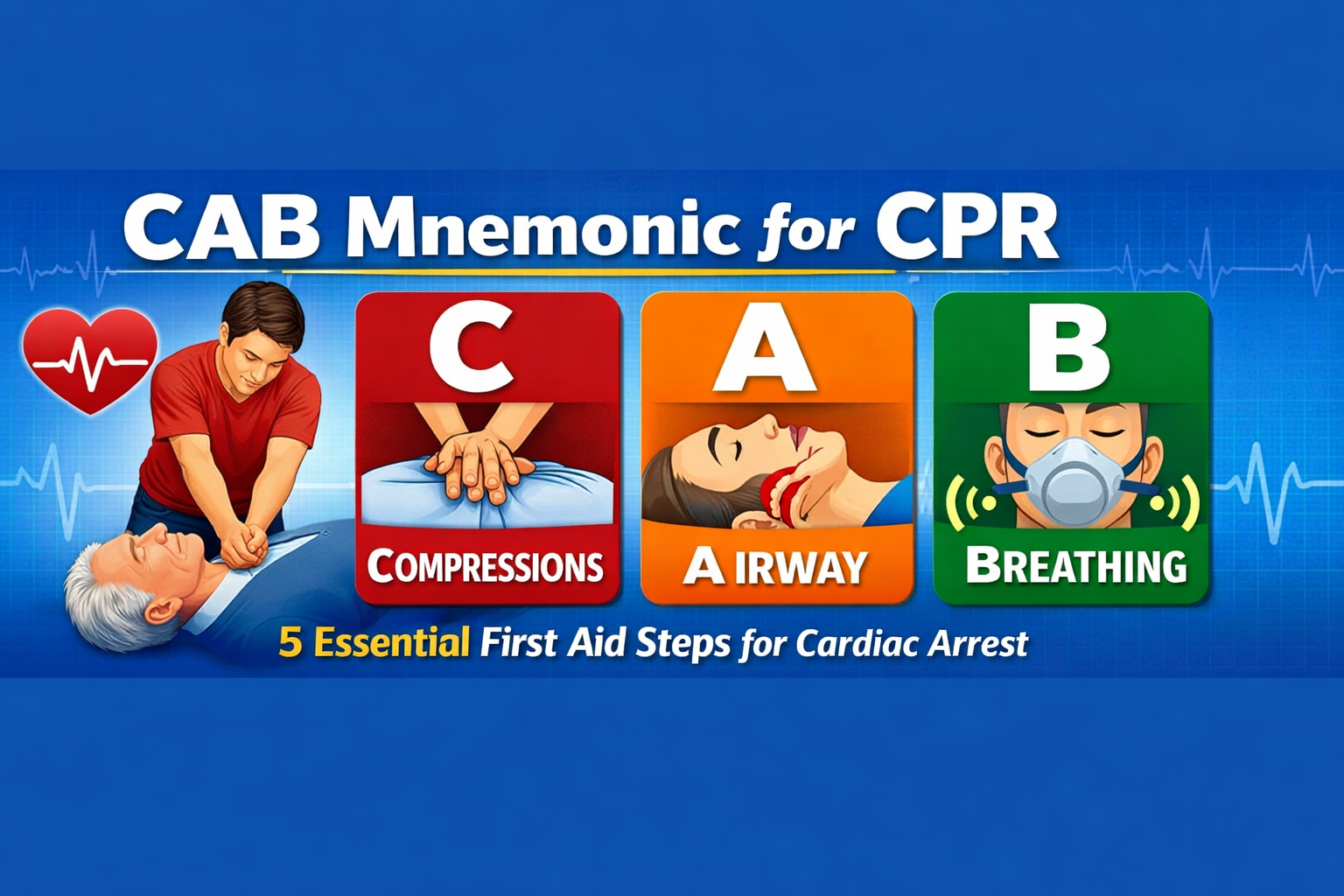
CAB Mnemonic for CPR: 5 Essential First Aid Steps for Cardiac Arrest
#Medical Surgical
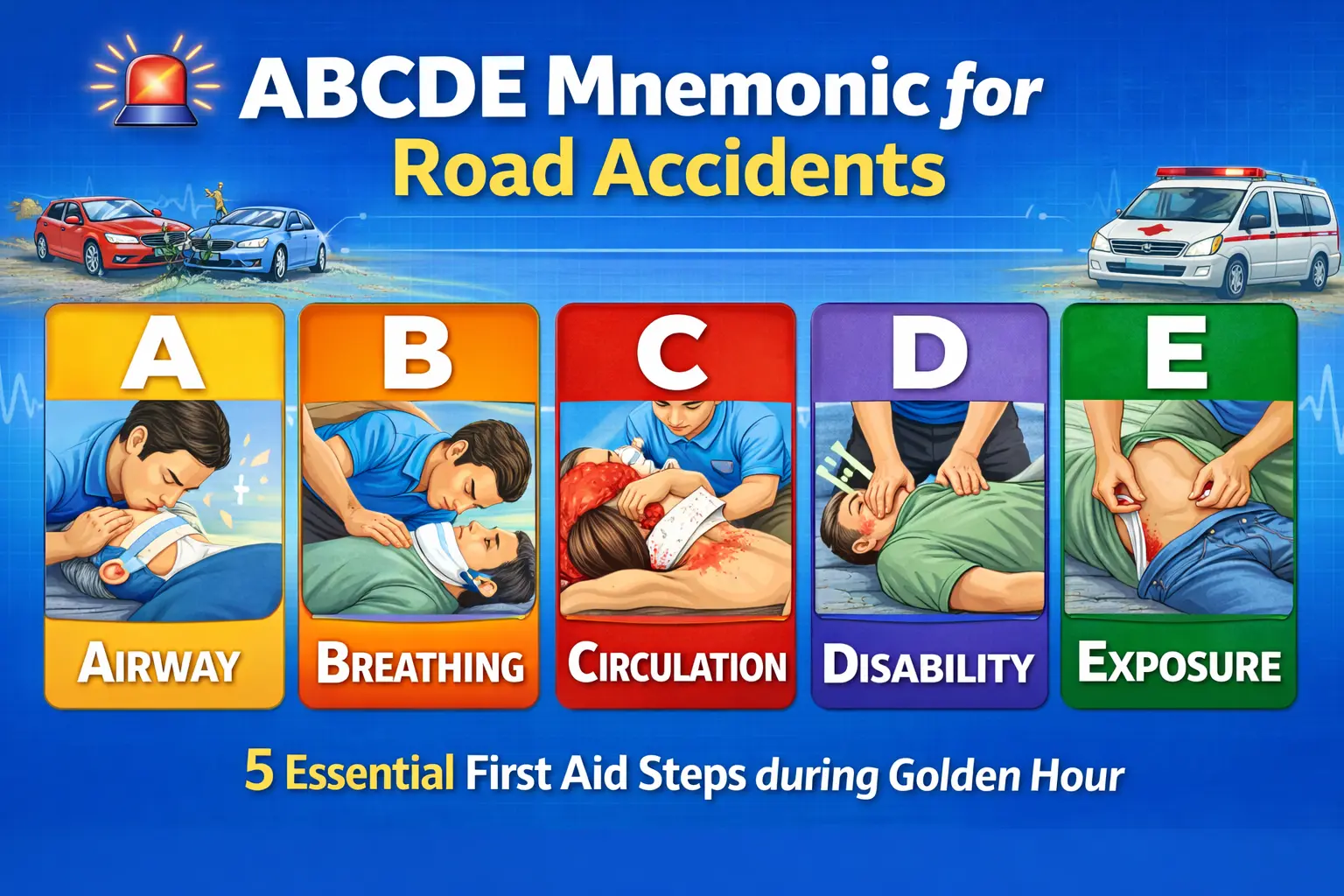
Emergency First Aid Mnemonics: Golden Hour ABCDE Guide for Road Accident Response
#Medical Surgical
Latest Blog Posts

MP PNST 2026: Application Form Out – Apply Online from 09 to 23 June 2026
June 9, 2026

Scientists Discover How Humans Could Recover Lost Vision — A 2025 Breakthrough That Changes Everything
June 1, 2026

Daraxonrasib: The New Daily Pill That Doubled Survival Time in Pancreatic Cancer — A Complete 2026 Guide
June 1, 2026

PGIMER BSc Nursing Admission 2026 — Apply Online, Seats, Exam Date & Complete Schedule
May 31, 2026
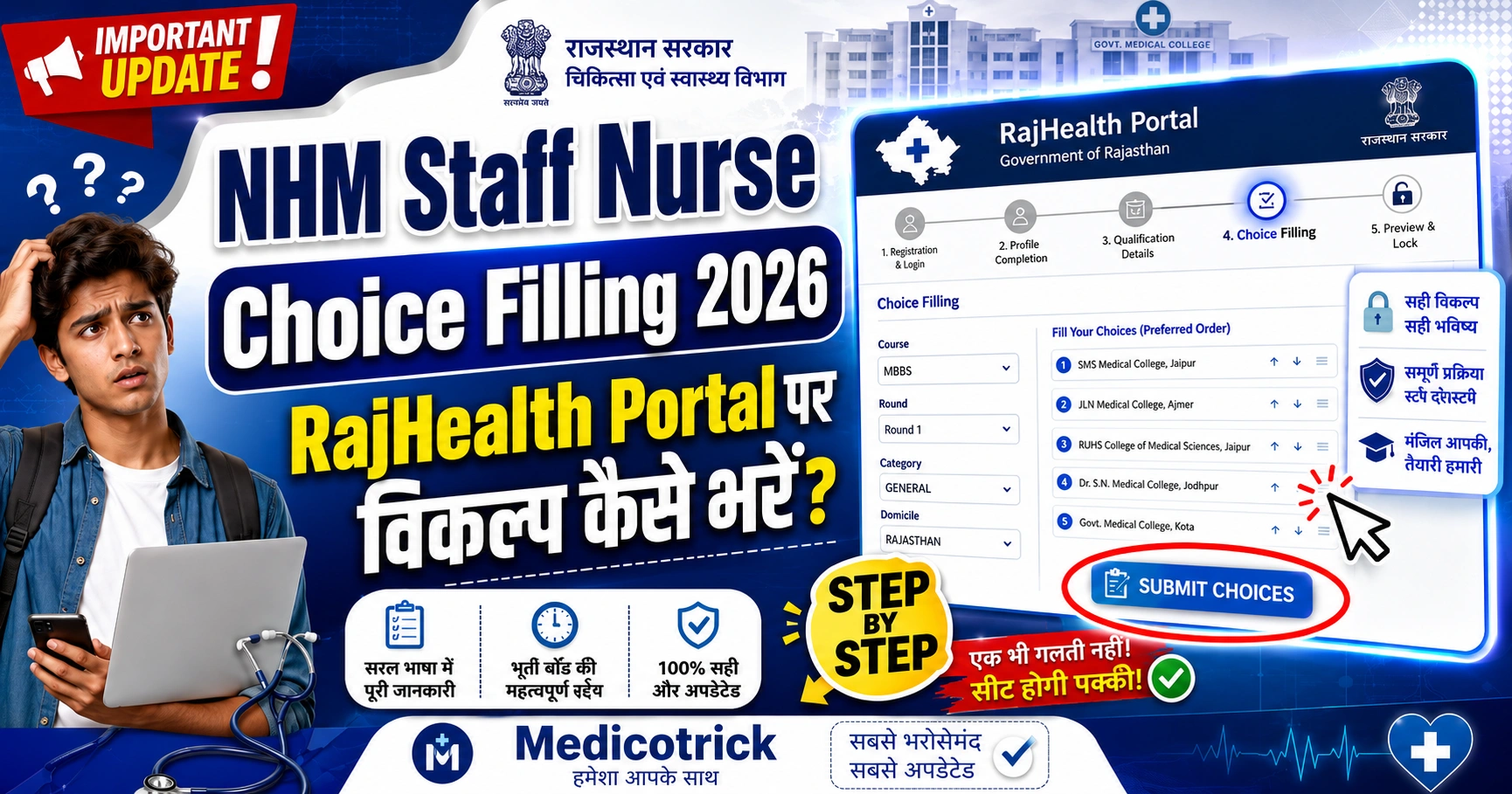
NHM Staff Nurse Choice Filling Guidelines 2026: RajHealtH Portal पर विकल्प कैसे भरें?
May 27, 2026