
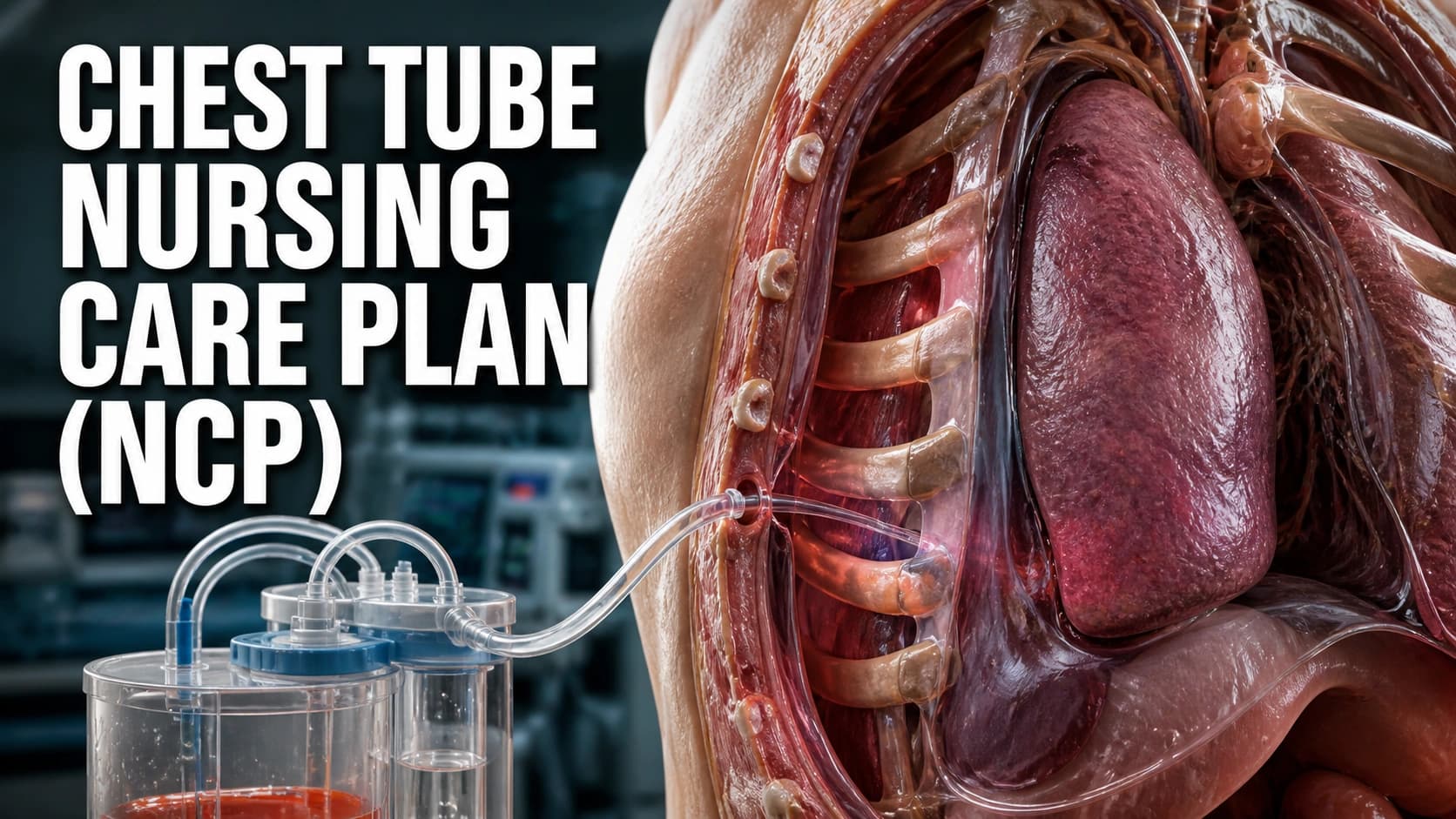
Chest Tube Nursing Care Plan (NCP): NANDA Diagnoses & Interventions
Managing a patient with a chest tube requires critical thinking, constant respiratory assessment, and precise nursing interventions. Whether you are creating an assignment for nursing school, Whether you're preparing for the NCLEX, or getting ready for your clinical shift, having a structured nursing care plan (NCP) for a patient with a chest tube is essential.
At MedicoTrick, we have simplified the most globally searched, evidence-based NANDA nursing diagnoses for chest tube management. This comprehensive guide covers priority nursing tasks and their precise diagnostic rationales to ensure the patient's complete safety.
Priority 1: Impaired Gas Exchange
Related To: changes in the alveolar-capillary membrane, alterations in oxygen supply, and ventilation-perfusion mismatch (often due to an underlying pneumothorax, hemothorax, or pleural effusion).
As Evidenced By: dyspnea, tachypnea, decreased oxygen saturation (SpO2 < 92%), restlessness, or use of accessory respiratory muscles.
Nursing Interventions & Rationales
Nursing Interventions | Rationale |
Assess respiratory status continuously: Monitor respiratory rate, depth, rhythm & auscultate lung sounds in every 1-2 hours. | Early detection of respiratory distress or complications (such as tension pneumothorax and chest tube obstruction) makes immediate life-saving intervention possible. |
Maintain proper positioning: Keep the patient in Semi-Fowler’s / High-Fowler’s position. | Elevating the head of the bed increases lung expansion, improves gas exchange, and also aids in the drainage of fluids through gravity. |
Administer supplemental oxygen: Provide O2 as prescribed to maintain SpO2 > 95%. | Maximizes the oxygen available for cellular exchange & directly reducing tissue hypoxia. |
Monitor the chest drainage system: Ensure the water seal is intact, check for tidaling, & verify that the drainage unit remains strictly below chest level. | A damaged system can allow atmospheric air to enter the pleural space of the lung, causing it to collapse and severely impairing gas exchange. |
Priority 2: Ineffective Breathing Pattern
Related To: Severe pain at the site of chest tube insertion, severe anxiety, or the inability to fully expand the lungs.
As Evidenced By: Shallow breathing, tension in the chest wall, rapid breathing, or reluctance to take deep breaths and cough.
Nursing Interventions & Rationales
Nursing Interventions | Rationale |
Administer analgesics proactively: Pain medication should be given 30 minutes before deep breathing exercises, coughing, or repositioning. | Pain is the primary reason patients with chest tubes take shallow breaths. Effective pain management enables full lung expansion without discomfort. |
Teach the use of an Incentive Spirometer (IS): Instruct the patient to use IS 10 times every hour while awakeup . | Deep breathing can prevent the collapse of the lung (atelectasis) and also helps push the remaining air or fluid from the pulmonary membrane area into the chest tube |
Assist with splinting the chest: Be sure to teach the patient how to press a pillow against the chest at the site where the chest tube is inserted when coughing. | Splinting provides physical support to the incised area, which reduces pain and enables a more forceful, effective cough to clear secretions from the airway. |
Priority 3: Risk for Infection
Related To: Invasive procedure, presence of a foreign body (chest tube) in the pleural cavity & compromised skin integrity.
Nursing Interventions & Rationales
Nursing Interventions | Rationale |
Perform strict hand hygiene: Be sure to wash your hands thoroughly before and after any contact with the patient or the chest drainage system. | Hand hygiene is the simplest & most effective way to prevent the transmission of healthcare-associated infections (HAIs). |
Perform sterile dressing changes: Strictly following hospital protocols, the dressing at the chest tube insertion site was changed using a sterile, non-active technique. | The entry site provides a direct pathway to the pulmonary cavity. Therefore, a sterile closed dressing prevents atmospheric bacteria from entering. |
Monitor for systemic and local signs of infection: Also be sure to check for fever, a rapid heartbeat, purulent discharge at the site, or a sudden increase in white blood cell (WBC) count. | Antibiotic therapy should be initiated immediately upon early identification of an infectious process (such as an empyema). |
Ensure system is sealed and secure: All tubing connections must be taped securely using the spiral or “chevron” method. | It also prevents accidental disconnection, which exposes the sterile internal system to environmental pathogens. |
Ready to Master Chest Tube Emergencies?
Do you want to know what to do during chest tube slippage or air leak?
Be sure to check out our complete [Chest Tube Troubleshooting and Emergency Cheat Sheet] to master your clinical skills and excel in your exams!
Stay Updated with Medicotrick
Get latest nursing job alerts, official PDFs & study tricks straight to your phone. Join our growing community today!
🟢 WhatsApp (71K+ Members): [Click to Join]
✈️ Telegram (PDFs & Notes): [Click to Join]
▶️ YouTube (Prep & Mnemonics): [Subscribe Here]
📸 Instagram (Daily Quizzes): [Follow Us]
📘 Facebook (Aspirants Community): [Like Page]
Frequently Asked Questions (FAQs)
Q.1 What is the primary nursing assessment for a patient with a chest tube?
The primary assessment is to evaluate the patient's respiratory status. This includes checking the respiratory rate, oxygen saturation, auscultating the lungs, and also ensuring that the chest drainage system is open and functioning properly (checking for tidying and preventing air leaks).
Q.2 Why is it important to keep the chest drainage system below the patient's chest?
Keep the drainage system below the level of the chest so that gravity can pull fluid and air out of the pleural space. If it is raised above the chest, fluid can drain back into the pleural space, increasing the risk of infection and lung collapse.
Q.3 What should a nurse do if the chest tube accidentally disconnects from the drainage unit?
If the tubing becomes disconnected from the drainage system, the nurse should immediately submerge the end of the patient's chest tube in a bottle of sterile water (about 1-2 inches deep) to create a temporary water seal until a new drainage system can be attached.