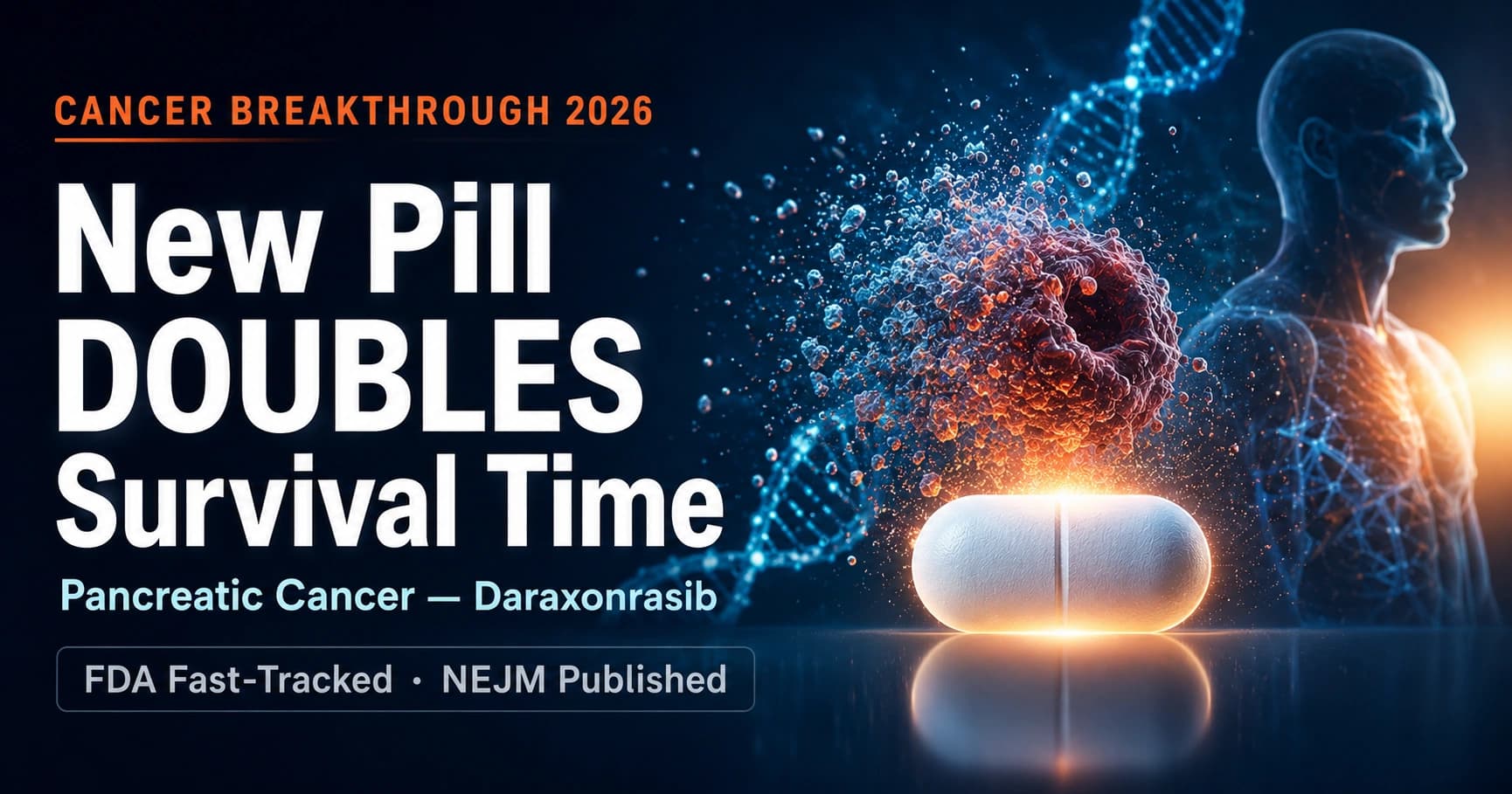
Daraxonrasib: The New Daily Pill That Doubled Survival Time in Pancreatic Cancer — A Complete 2026 Guide
Introduction: A Historic Moment in Cancer Medicine
For decades, pancreatic cancer has been one of medicine's most feared diagnoses. The survival statistics are devastating — only 3% of patients with metastatic pancreatic cancer survive beyond five years. Chemotherapy offers only modest benefits, often giving patients just 6 months of extra time while causing severe side effects.
But on May 31, 2026, everything changed.
At the American Society of Clinical Oncology (ASCO) Annual Meeting in Chicago, researchers unveiled Phase 3 trial results for a new drug called daraxonrasib — and the oncology world erupted. The drug, a daily oral pill made by Revolution Medicines, doubled survival time in advanced pancreatic cancer patients compared to standard chemotherapy. The results were simultaneously published in the New England Journal of Medicine, the world's most prestigious medical journal.
Doctors who have spent careers treating pancreatic cancer called it "unprecedented," "a game-changer," and historic — and the data backs every word.
What Is Daraxonrasib? (Simple Explanation)
Daraxonrasib (also written as RMC-6236) is an oral RAS(ON) multi-selective inhibitor — meaning it is a targeted cancer pill taken by mouth once daily.
Here's the simple explanation:
Most pancreatic cancers are driven by a mutation in a gene called KRAS. Think of KRAS as an on/off switch that controls how cells grow. When KRAS mutates, this switch gets stuck in the "ON" position — causing cancer cells to grow wildly and uncontrollably.
For over 30 years, scientists tried to design a drug that could block this mutated KRAS protein. It was considered nearly "undruggable" because the mutated protein's smooth, round surface gave drugs nothing to grip.
Daraxonrasib solved this problem through a remarkable mechanism: it works like a "molecular glue." It pairs with a protein called cyclophilin A inside cells, forming a complex that successfully sticks to the mutated RAS protein and blocks it.
"It's been incredibly hard to drug that mutation... through some really amazing chemistry work, scientists have been able to develop a drug to work on the mutation." — Dr. Brian Wolpin, Dana-Farber Cancer Institute
The Phase 3 Trial: RASolute 302 — The Numbers That Shocked the World
The pivotal clinical trial, called RASolute 302 (NCT06625320), enrolled 500 patients with previously treated metastatic pancreatic cancer. Patients were randomly assigned to receive either daraxonrasib or chemotherapy.
📊 Key Results at a Glance:
Metric | Daraxonrasib | Chemotherapy |
|---|---|---|
Median Overall Survival | 13.2 months | 6.7 months |
Progression-Free Survival | 7.2 months | Significantly lower |
Disease Control Rate | ~90% | Lower |
Objective Response Rate | ~30% | Lower |
Serious Side Effects (Grade 3+) | 43.6% | 57.5% |
The hazard ratio was 0.40 (p < 0.0001) — meaning patients on daraxonrasib had a 60% lower risk of death compared to chemotherapy. In clinical trial terms, this is an extraordinary result.
Additionally, around 90% of all patients who received the drug experienced disease control — meaning their cancer was either reduced or stabilized.
Who Does Daraxonrasib Work For?
This is perhaps the most exciting part. While the drug targets KRAS mutations, the Phase 3 results showed that all patients with metastatic pancreatic cancer benefited — even those without a confirmed KRAS mutation.
KRAS mutations drive over 90% of pancreatic cancers
Daraxonrasib is active against multiple KRAS mutation types: G12D, G12V, G12R, Q61X, and others
This means the drug is potentially relevant to nearly every patient with advanced pancreatic cancer
"Based on the data we have now, I think this drug is relevant to all patients with pancreatic cancer, assuming that they have metastatic cancer." — Dr. Brian Wolpin
Real Patient Story: "I've Been Given a Second Chance"
Debby Orcutt, 71, from Spencer, Massachusetts was diagnosed with Stage 4 pancreatic cancer in April 2024. By the time she was diagnosed, the cancer had already spread to her liver.
When chemotherapy began failing her, she enrolled in the daraxonrasib clinical trial. She received the actual drug — not chemotherapy.
The results were remarkable:
The spot on her liver completely vanished
The tumor on her pancreas shrank by 80%
She reports feeling "great every single day"
Today, Debby helps her grandchildren get to school and works part-time. Her husband Ron still sets alarms to ensure she takes her pills on an empty stomach, exactly two hours after breakfast.
"You've just got to keep going and have faith. I feel like I've been given a second chance, and might as well make the most of it." — Debby Orcutt
What Are the Side Effects of Daraxonrasib?
Compared to chemotherapy, daraxonrasib has a more manageable side effect profile:
Skin rash (looks like a bad sunburn) — occurs in ~90% of patients; manageable with antibiotic creams and sun protection. About 15% develop a more serious rash requiring temporary treatment pause.
Vomiting and diarrhea
Mouth sores (similar to canker sores)
Must be taken on an empty stomach once daily
Serious adverse events (Grade 3 or higher) occurred in 43.6% of daraxonrasib patients vs 57.5% of chemotherapy patients — meaning chemotherapy actually caused more severe side effects.
FDA Status: Where Does Daraxonrasib Stand?
✅ FDA Breakthrough Therapy Designation — granted June 2025
✅ Commissioner's National Priority Voucher — selected to accelerate FDA review
✅ Expanded Access Program (EAP) — approved May 1, 2026; allows eligible patients to access the drug outside of clinical trials right now
🔄 New Drug Application (NDA) — Revolution Medicines preparing submission; company working "24/7" to file
The FDA has essentially put daraxonrasib on its fastest possible approval pathway. An official approval decision is expected in the near future.
Beyond Pancreatic Cancer: The Drug That Could Change All of Oncology
Here's what makes daraxonrasib potentially even bigger than the pancreatic cancer headlines: KRAS mutations are found across many cancer types.
The same molecular target that daraxonrasib attacks in pancreatic cancer also drives:
Lung cancer
Colorectal (colon) cancer
Ovarian cancer
Endometrial cancer
Bile duct cancer (cholangiocarcinoma)
Clinical trials for daraxonrasib in these cancer types are already underway. Revolution Medicines also has three additional RAS inhibitor drugs in clinical trials, with a fourth starting later in 2026.
"Pancreas cancer may be the first for this drug, but there will be others. Now the floodgates open." — Dr. Brian Wolpin, Dana-Farber Cancer Institute
Why Pancreatic Cancer Is So Deadly — and Why This Drug Matters So Much
To understand why daraxonrasib's results are so significant, you need to understand the brutal reality of pancreatic cancer:
Over 60,000 Americans are diagnosed with pancreatic cancer every year
Most cases are diagnosed at Stage 3 or Stage 4 — when surgery is no longer an option
With best-available chemotherapy, average survival is just 6 months after second-line treatment
Only 3% of patients with metastatic disease survive 5 years
For over 30 years, no new targeted therapy successfully changed these numbers. Chemotherapy remained the only option. Hundreds of clinical trials failed.
Daraxonrasib is the first drug to break this barrier — not by a small margin, but by doubling survival time.
What Doctors Are Saying: Reactions From the Medical World
The medical community's response has been extraordinary:
"It's that big of a game-changer for those of us who treat pancreatic cancer. It's unprecedented." — Dr. Rachna Shroff, University of Arizona Cancer Center
"There's not a doubt in my mind that the second it becomes available, I will start using it." — Dr. Rachna Shroff
"This is the first step to show we can stop using so much chemotherapy." — Dr. Brian Wolpin
"Treatment after treatment for second-line treatment for pancreatic cancer has failed in clinical trials. Daraxonrasib seems to have broken the losing streak." — Dr. Shubham Pant, MD Anderson Cancer Center
How Is Daraxonrasib Taken?
Form: Oral pill (taken by mouth)
Dose: 300 mg — taken as 3 pills once daily
Timing: Must be taken on an empty stomach
Convenience: No IV infusions required — unlike traditional chemotherapy
This is a significant quality-of-life improvement. Patients take a pill at home instead of sitting for hours in a chemotherapy infusion center.
Frequently Asked Questions (FAQ)
Q.1: Is daraxonrasib FDA approved?
Answer: Not yet officially approved, but it has FDA Breakthrough Therapy designation, is on the Commissioner's National Priority Voucher fast-track, and has an active Expanded Access Program. Full approval is expected soon.
Q.2: Can I get daraxonrasib right now?
Answer: Yes, through the Expanded Access Program (EAP) for eligible patients with previously treated metastatic pancreatic cancer. Talk to your oncologist about eligibility.
Q.3: Does daraxonrasib work for all pancreatic cancer patients?
Answer: Phase 3 data showed benefit for all patients with metastatic pancreatic cancer, not just those with confirmed KRAS mutations. Researchers believe it is relevant to nearly all patients with advanced disease.
Q.4: What makes daraxonrasib different from previous KRAS drugs?
Answer: Earlier approved RAS inhibitors target a specific KRAS mutation (G12C) that is rare in pancreatic cancer. Daraxonrasib is a "multi-selective" inhibitor — it works against multiple KRAS mutation types common in pancreatic cancer, making it broadly applicable.
Q.5: Will daraxonrasib work for other cancers?
Answer: Research is actively underway for lung, colon, ovarian, and other KRAS-driven cancers. Early results are promising.
Read More:- The Hidden Crisis of Weight Loss Drugs
Read More:- Peppermint Oil for High Blood Pressure